Conan the Rebel Book Review Rambling Conan Blog David Thomas
Welcome back to the latest installment of Hither Came Conan, where a leading Robert E. Howard expert examines 1 of the original Conan stories each week, highlighting what's best. Jason Durall is the line editor for Modiphius' RPG, Conan: Adventures in an Age Undreamed Of.
Xuthal of the Dusk on 25 Lunas a Day
Of all of Howard's Conan stories, "Xuthal of the Dusk" is one of his most emblematic, regardless of its quality compared to the other. If ane were to assemble a tasting menu of Conan containing all his recurring themes and story elements, ane could look no farther than this story and come away with a good sense of the whole. With only one glaringly weak point, the story is an underappreciated jewel and worth reconsidering in its place amongst the overall catechism.
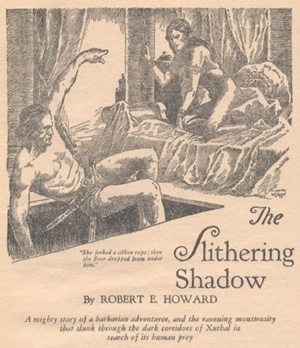
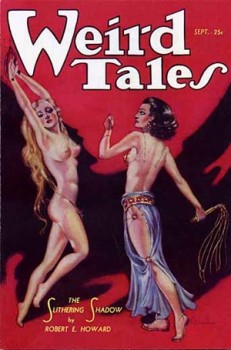
First appearing in the September 1933 upshot of Weird Tales under the title "The Slithering Shadow", the story, like many of Howard's tales, was graced with an extremely risqué cover by Margaret Brundage, no modest contributor to the magazine's sales (more on this later). Though the story's published title was "The Slithering Shadow", Howard, in a letter to Clark Ashton Smith, clarifies that its original championship was "Xuthal of the Dusk". Given a choice betwixt the title the story was written nether versus a title provided past the editor, let usa remain true to Howard's preference in the matter.
"Xuthal of the Dusk" may not be the best of the Conan stories, only it is 1 of the purest Conan stories. Let'due south examine all the notes this story hits, and this should become clear.
 Greatest Hits
One of the showtime and foremost of the themes Howard evoked and explored throughout the Conan stories was his dissimilarity between the barbaric and civilized worlds. He believed in the superiority of the barbaric world (where boldness, self-sufficiency, resilience, and communion with the natural earth are common characteristics) versus the conceit of civilization (with vices ranging from weakness, decadence, degeneracy, or at best, naivete and helplessness). Throughout this story are indications about the failures of the folk of Xuthal.
They are a people at the verge of extinction, fabricated helpless by drugs, unwilling and afraid to defend themselves or even flee from the monster they worship. They are sexually degenerate to a degree that impresses an initiate of a fertility goddess of the Southern Kingdoms and in that location are fifty-fifty more than, smaller, seemingly throwaway details, such equally the use of gold bars on a window (why would anyone make bars out of golden?) Finally (or possibly from the very commencement), information technology'southward there in the original title itself, calling Xuthal a city "of the Dusk".
The moral ambivalence of the Hyborian Globe (and many of Howard'south historics) is well on brandish in this story. The backstory puts Conan equally part of Prince Almuric'southward one thousand regular army cutting a swath across Shem, Stygia, and Kush for no provided purpose. Conan takes a slave, and she stays with him because the alternative is much worse. He contemplates killing Natala to spare her any future misery, simply mocks and mistreats her when they observe shelter.
The folk of Xuthal have given up entirely on any societal imperatives such as survival or bettering their lot, and the Stygian Thalis is boastfully amoral but seems wholly devoted to sensuality versus pursuing some philosophical goal.
Howard loved his precursor civilizations, such equally his mysterious original builders of the dark-green stone cities, some in ruins, some withal occupied by newcomers, and "Xuthal of the Dusk" gives usa its titular metropolis, a identify whose origins are somewhat vague (Thalis isn't sure) but certainly has all of the characteristics of many of his other mysterious ancient cities.
Similarly, it features Howard's use of incredibly advanced scientific discipline lost to the current era, a trope popularized past Blavatsky and others in and outside of fiction. "Xuthal" has weird pulp science galore in the form of radium gems and nutrient replicating techniques and then avant-garde they can create joints of meat capable of passing equally the existent thing. The story besides has the only example of a proper "magic" sword with apparent king of Xuthal's "sword that sparkled frostily in the radium light."
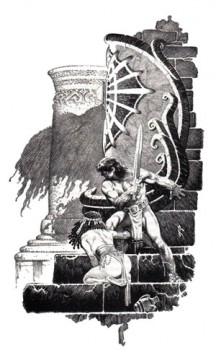
Howard's liberal utilize of Lovecraftian horror elements and techniques, done with the limited purpose of cementing his Hyborian Age into Lovecraft's own proto-history, is obvious here in the presence of Thog, a demonic creature and so overtly Lovecraftian that its very name itself is a distillation of Tsathoggua. The demonic entity from vast abyss beneath Xuthal is masterfully described, perhaps even more so than Lovecraft ever described i of his own alien entities. The passage when the captive Natala encounters Thog, creeping towards her, in the tunnels beneath Xuthal, is a master course in portraying a creature that does not conform to the laws of nature, and flagrantly disobeys the laws of physics itself.
Sexuality, straightforward or weird is also prevalent throughout the story in one case Conan and Natala reach Xuthal. While Conan shows Natala niggling sign of any amore or fifty-fifty a recognition of her gender (she might every bit well be a small child in the story prior to Xuthal), the offset native of Xuthal they speak with tries to seduce her, and the second, Thalis, brazenly throws herself at Conan in front of Natala, emphasizing the extent of the decadence she has learned from the people of Xuthal, and suggesting that she alone can provide sensual pleasure greater than their dreaming stupors. Natala's whipping scene is clearly there for prurient reasons, but is immediately followed by Thalis' offscreen death, the sounds of which are described in such a way leaving trivial doubt that her death was not a "clean" one.
Though this is non strictly unique to Howard but is a characteristic of many pulp stories, at that place are dramatic reversals of fortune aplenty hither, from Conan and Natala going from existence part of a keen ground forces to its only credible survivors, their most-death from estrus exposure to the shelter of Xuthal, Conan pursued by a mob of enraged men of Xuthal and falling through a trapdoor merely to land virtually Natala just as she needs him most, to his well-nigh-death land being washed abroad with a drink of the seemingly magic ambrosia of Xuthal.
Finally, the depiction of visceral combat has no equal hither, no other single fight in the entirety of the Conan stories is every bit barbarous, suspenseful, and as thoroughly described as is his battle with the demon-god Thog. While it'south obvious that the protagonist of a story ordinarily emerges alive at the stop, this is 1 of the few Conan stories where a fight ends and the reader is genuinely concerned at how he's going to get through the next folio, much less make information technology to his next story.
The Purity Test
As stated earlier, "Xuthal of the Dusk" is ane of the purest Conan stories, if not the all-time. Purity is a much easier quality to judge than quality, and this story is unadulterated Conan. Due to the highly-adaptable nature of Conan himself and the genre-switching Howard did based on his own interests in the moment, the market at the time, and whatever his immediate inspiration was, the Conan stories are often less Conan stories than they are genre stories starring Conan (or sometimes not fifty-fifty starring Conan at all, such every bit with "A Witch Shall be Born" and "Beyond the Black River"). "Xuthal of the Dusk", yet, is clearly a Conan story through and through, with all the elements that support and highlight his role in the setting, and for this, it should be given special consideration when its relative quality is discussed.
There'south Something Virtually Natala
The veritable fly in the golden elixir, which many critics rightfully indicate to, is unfortunately its but sympathetic female graphic symbol, Natala, the Brythunian slave. It isn't clear what the nature of their human relationship is — Conan either owns her or merely keeps her around and protects her — but given the range of options, information technology's non likely to be for peculiarly altruistic reasons.
From the opening scene where she's sitting on the ground clutching at his knee, to the very side by side scene where Conan contemplates killing her to spare her any unbearable hardship, Natala is an unfortunate but necessary part of the story and consistently its weakest point. She generally only states the obvious or asks questions that take no articulate answer and by and large is either in the style or needs to exist rescued.
Even her old protector, Conan, shoves her unceremoniously into a chair when they discover food, slaps her ass when she gets frightened, and afterward derides her when she accepts Thalis's offer of a place to clean herself. She's clearly a comely, full grown woman, just Thalis and Conan both accost her equally if she were a child. All of this, however, pales next to her humiliating, luridly-described, and wholly gratuitous whipping at the easily of the Stygian temptress.
If the goal of the scene was to brandish how insane Thalis was, past having her finish to whip a captive while a demon god is actively stalking the halls of the urban center hunting for fresh victims, and so it serves that point and few others. This event, clearly, was Howard making a bid for comprehend art status, equally Brundage'south covers sold better than others and she often picked which story to illustrate: the saucier and more provocative, the better.
All that said, though, and it's not exactly like shooting fish in a barrel to figure out what could accept been washed differently with the character. Remove Natala entirely from the story and it'due south a "Conan finds lost city" yarn with no emotional stakes. He arrives, encounters a few Xuthal dreamers, meets Thalis, probably beds her, and either escapes the city the next day with a pocketbook of stolen gold, or is captured and served up to Thog. It's serviceable, simply non particularly engaging. If Natala becomes a more independent grapheme, then the contrast betwixt she and Thalis is not so well-defined, and Conan'due south defense of her becomes less benevolent. It's difficult to tell. Perhaps some other typhoon and she might take emerged as a different graphic symbol entirely.

From the Dusty Scrolls (Editor comments)
The fight with Thog is written superbly: Ane of the best combat scenes in the entire Conan Canon. I contrast that with Conan'southward fight with the Lovecraftian-creature in "Vale of Lost Women." They are polar opposites in quality confrontations.
Fritz Lieber was not a fan, saying that the story was "repetitious and childish, a self-vitiating brew of pseudo-science, stage illusions, and the '18-carat' supernatural."
Conan had been part of Prince Almuric's rebel ground forces, which had been defeated in Koth, then "swept through the lands of Shem like a devastating sandstorm and drenched the outlands of Stygia with blood. With a Sygian host on its heels, information technology had cut its fashion through the blackness kingdom of Kush, merely to be annihilated on teh border of the southern desert." That story has non yet been told as a pastiche: non in de Army camp'southward series, the Tor books, or by anyone else. I exclude Dark Equus caballus – I oasis't read that story line all the same.
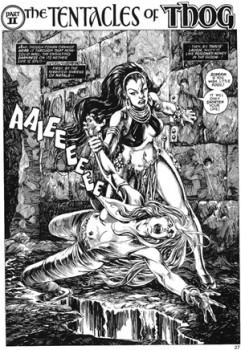
Dark Horse adapted this story for issues xiii – 15 of Conan – The Avenger. I have non read those issues. Marvel's Savage Sword of Conan covered it in issue 20.
Prior Posts in the Series:
Here Comes Conan!
The Best Conan Story Written past REH Was…?
Bobby Derie on "The Phoenix in the Sword"
Fletcher Vredenburgh on "The Frost Behemothic'southward Girl"
Ruminations on "The Phoenix on the Sword"
Jason Thousand Waltz on "The Belfry of the Elephant"
John C. Hocking on "The Cherry Citadel"
Morgan Holmes on "Fe Shadows in the Moon"
David C. Smith on "The Puddle of the Black One"
Dave Hardy on "The Vale of Lost Women"
Bob Byrne on Dark Equus caballus's "Fe Shadows in the Moon"
Next Calendar week it'southward Scott Oden with "The Devil in Atomic number 26"
Jason Durall combined two of his loves, role playing games, and Conan, when he became line editor for Modiphius' marvelous Conan: Adventures in an Age Undreamed Of. He is also the line editor for Chaosium'southward Runequest, as well as Basic Roleplaying.
 Bob Byrne'due south 'A (Black) Gat in the Paw' was a regular Monday morning hardboiled pulp column from May through December, 2018.
His 'The Public Life of Sherlock Holmes' column ran every Monday forenoon at Blackness Gate from March, 2014 through March, 2017 (still making an occasional return advent!).
He also organized Black Gate's award-nominated 'Discovering Robert Eastward. Howard' series.
He is a member of the Praed Street Irregulars, founded world wide web.SolarPons.com (the only website defended to the 'Sherlock Holmes of Praed Street') and blogs about Holmes and other mystery matters at Almost Holmes.
He has contributed stories to The MX Volume of New Sherlock Holmes Stories – Parts 3, Four, V and Vi.
And he will exist in the anthology of new Solar Pons stories coming this Spring.
Source: https://www.blackgate.com/2019/03/11/hither-came-conan-jason-durall-on-xuthal-of-the-dusk/
0 Response to "Conan the Rebel Book Review Rambling Conan Blog David Thomas"
Postar um comentário